Wednesday, June 30, 2010

A Facebook Exchange

I had an interesting exchange this morning, facebooking with a Christian-turned-atheist young friend. Because it dovetails into some of the current discussions here, I asked the friend if I could post our exchange here. He agreed, and it follows:

John

30 June at 08:52


So. I'm sure you more or less remember me, I used to go to your church. Well, a lot has changed since then, I've lost my religious side, and became atheistic. I realized that maybe I shouldn't just listen to what everybody has told me was true, and so I started first not with evolution but with the history of the bible. I started reading that the writers of the bible weren't even eye witnesses, let alone within decades of eyewitnesses. I started reading the bible more, Genesis 30:27-30 anybody? There were stories that we know are false that people just believe. It gave me reason to doubt. Now, I may be only 15, but I know I shouldn't just believe in a talking donkey. Since then, I've read. I've read a lot, I've studied evolution in and out, from the bad design of the recurrent laryngeal nerve to atavisms to the evolution of DNA, sex, death, movement, everything. I've found a passion of it. I've studied the laws of physics, mostly quantum mechanics and relativity. I've studied the fossil record in and out, looking at transitional fossils such as tiktaalik rosea, and I've looked at our own embryonic state (we develop a tail and an embryo sac..)


All this lead me to believe that there wasn't, couldn't be a god. What I had been raised believing was true, I realized wasn't. I started debating evolution with a pastor from Toledo. Honestly, I've never been more saddened by a person in my life. He's a pastor and he doesn't know anything about his own religion. He says everyone were eye witnesses. He says we have no evidence for macro or micro evolution, he brings up arbitrary ideas such as the laws of entropy, and then he questions me, he says that because I'm 15 I have to copy/paste all my answers to his questions. I met with him in person, and we went over carbon-dating. He says that the formula for half life, (y=ae^kt) must be wrong. He wouldn't tell me why. He told me I was going to hell for not believing in his god, and that his god was the only truth, and that I wouldn't be happy without him. I'm a lot happier now, without a god, than I was with one.


I've been reading your blog, and you seem like quite the intelligent person, who is interested in the same topics as I. It'd be nice to talk to someone as intelligent as you, who won't just say that we should believe in talking donkeys because the Bible tells us to.


Cliff Martin 30 June at 11:29


Thanks for writing, John. I enjoyed visiting with your mom yesterday.


I tracked with your first paragraph. Since you listened to me teach at TCF (I must apologize for passing along a lot of misinformation ... but that is all in the past), I too have developed a deep interest in DNA, sex (well, I've always been interested in THAT!), death, movement, quantum mechanics and relativity, even evolutionary psychology, etc. I understand how the recurrent laryngeal nerve drives the last nail into the coffin of "Intelligent Design". But when you write, "All this lead me to believe that there wasn't, couldn't be a god", I have to say that I have come to radically different conclusions. Surely the findings of science today, which are largely trustworthy, alter the ways we must think about God, and how we define him, and how we understand his involvement in the cosmos, etc. But how do they rule out the possibility of his existence?


I probably think more like you than your pastor friend. But I have not even come close to abandoning my hope that humans have infinite value, that suffering is not meaningless, that justice will prevail in the end, that we are more than chance chemical assemblages moving futilely through an ultimately inconsequential universe. In a way, I reject atheism because I reject its inescapable nihilistic despair. I choose hope. And such hope is, for me at least, richly rewarded and more than worth the risks involved!


But we all must choose. And our choices ought to be intellectually viable. That is why I say I have more in common with you. Fundamentalist Christians are either uninformed of the current state of science (and willfully remain so) or they live with a cognitive dissonance that would for you or me be unbearable. But is this the result of TRUTH, or the result of religious constructs designed in fear and maintained for the manipulation and control of the religious masses? It is clearly the latter, in my opinion.


Before you discard the bathwater, I highly recommend that you reconsider the baby!


As for the debate with your friend; Christians who reject carbon dating do so because they feel they must. They do not understand carbon dating. But they find great comfort in the relative few anomalies in the process which are well understood by scientists, but appear ridiculous to the lay-person. Such people will typically say things like, "no one knows what happened 200 million years ago because no one was there!" So I use a different tack with friends who reject ancient evidence:


I ask them to consider the same basic evidence that first convinced Darwin (and many of his contemporaries) of evolution in a time before much fossil evidence had been discovered, and we knew nothing about carbon dating, radioactive dating, DNA, etc. Darwin (if I'm not mistaken) was convinced by two things: 1) The newly developing understandings of Mendelian Inheritance (which no one denies), but even more so by 2) Biogeography, or the consistent patters of distribution of the flora and fauna throughout the earth, particularly on the islands of the world. These patterns are everywhere consistent with the predictions of evolutionary theory, and are weird to the extreme if we postulate special creation of the species. And this evidence is available to anyone today, requires no dating methodologies, no reliance upon the "witness" of “biased” paleontologists, and can be analyzed by anyone willing to THINK, without the huge learning curve on the front end of DNA evidence.


Ask him what logic can explain why a creator went out to all the islands of the world and proceeded to create life so as to make the earth look exactly as it would if it had been populated by living organisms over 100s of millions of years through the very process Darwin describes.


I have a limited respect for the few (very few) Creationists who actually understand the evidence for evolution and explain it this way: God made the cosmos to appear as though it had evolved (à la the Big Bang) and life appear as though it has evolved (à la Darwin) to find out if we would believe him when he declares that it all happened in 6 days, a mere 6,000 years ago. They make God into a trickster and a deceiver, an insecure person who so fears rejection that he actually sets it up (some sick people actually do that, you know).


Let's talk sometime.


Friday, June 25, 2010

Personal: Thank you Michael!

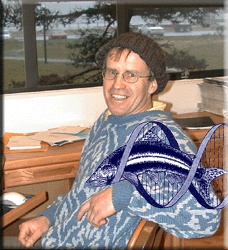
I've just returned home from a delightful morning spent with a new friend, Michael Banks. Michael is a research professor at Oregon State University Hatfield Marine Science Center (in Newport, OR) specializing in marine population genetics. We enjoyed a two-hour visit over breakfast, after which Michael treated me to a tour of his offices and laboratories at the Center, where I met several of his students (one of whom gave me a really cool baseball cap!), and got a feel for how geneticists do their work. What a treat!


Michael is a rare find in this little outpost of Lincoln County, Oregon. Christians who truly understand and fully accept evolution, and maintain a deep belief in and love for God, are few and far between here. Michael is a delightful conversationalist, a deeply insightful believer, a leading scientist in his field; and he is a man who recently lost a brother (in his native country of South Africa) to cancer. He walked alongside Ginger and I through the final months of her battle. So when we are together, the list of topics for conversation is lengthy indeed.


This is my public "Thank you" to Michael for the gift of his valuable time. And here's to many more similar visits if the Lord has that in store for us!

Monday, June 21, 2010

Suffering: Is there a deeper truth?

Everyone suffers. We all experience pain, physical, mental, or emotional, in lesser or greater degrees. Most believers look for, and usually find, some redeeming personal benefits in suffering experiences. For on a personal level, suffering, that unwelcome tutor, perfects and refines faith and character. Romans 5 and James 1 teach this idea; Peter in his first epistle seems to be almost stuck on the theme. He must have had impetus to think long and hard about the sufferings Christians endure.


However, my thoughts about suffering go more to the abstract. Suffering can perfect our souls, that is clear. But both Peter and Paul speak of suffering accomplishing something beyond personal refinement. There is something "out there" that is directly effected by our suffering. And there are direct eternal consequences both personal and cosmic which cannot simply be understood as a silver lining on the cloud.


Nor does our acknowledgment of personal benefit from suffering address the philosophical and ontological questions about pain, evil, and suffering. Why is there so much suffering? The suffering that we humans have experienced in our relatively short history, horrifying as it is, even monstrous, is but a tiny fraction of the massive quantity of animal suffering which has accrued over our evolutionary past. When Tennyson speaks of nature, "red in tooth and claw", the context is his own effort to make sense of an untimely death, of his own personal loss and suffering, but even his very deep sorrow is but a whisper against the deafening roar of pain and (seemingly) senseless torment in the ages-long story of life. Such considerations shook his faith to the core. Most believers I know never go there. Sadly. Because when we fear to ask the questions, we'll never see the answers even when we stumble over them.


I am convinced that we can find, just below the surface of the scriptures, a rich lattice of understandings about suffering. There remain some unanswered questions, to be sure. Scripture does not speak to our curiosity. But there is, I think, enough information to suggest that suffering, perhaps all suffering, is profoundly meaningful, imbued with dignity and ultimate purpose. I do not believe that any suffering is senseless, unaccounted for, or lost in the economies of the cosmos, or in its ages-long clash of good pitted against evil. Exactly how suffering shapes this cosmic battle, or why suffering plays such a central role in it, I cannot say. But that it does so is a salient concept in both testaments of the Bible.


The Jewish people, from O.T. times right up to the present, have viewed themselves as the "suffering servant" of God. They exhibit a faith that no suffering is in vain; that their national history, marked by injustice and suffering, serves some divine purpose. They may not understand how, but it is enough for them to view their collective pain as service to Jahweh. Christians have failed, I believe, to carry this idea forward; and that to our great loss. Perhaps this is due to the Christian notion that Jesus paid the final debt in full, that he suffered and died to save us from suffering and death. But this is the case neither in N.T. teaching nor in our experience. The drumbeat of human suffering is unabated, even in the lives of the faith-filled followers of Jesus. And the N.T. is replete with warnings that this will be the case. Paul goes so far as to say that we, in our sufferings, complete something that was unfinished in the sufferings of Christ (Colossians 1:24).


Clearly, the sufferings of Jesus were efficacious toward some cosmic goal, some large-scale overriding purpose of God. The gospel writers paint the death of Jesus as a (literally!) earth shaking event. Some of the powers of the enemy were perhaps permanently depleted that day. The evil one was, in a symbolic way at least, utterly defeated in the sufferings and resurrection of Jesus. But Paul makes it clear: even the sufferings of Jesus did not finish the work. Thus are we offered the exceeding high calling of "sharing in his sufferings" (Philippians 3:10). And thus Peter instructs us to get ready, to arm ourselves with the "mind to suffer" (1 Peter 4:1) and to rejoice when we "participate" in his sufferings (1 Peter 4:13).


Paul and Peter both link suffering to future glory. In fact, they use language that suggests some fixed ratio in which future glory is directly proportional to suffering. I have heard preachers who merely understand this as a kind of compensatory reward, glory being handed out as a sort of heavenly "atta-boy". But Paul paints a far different picture. In 2 Corinthians 4, he describes the processes whereby sufferings work in us toward eternal purposes. Sufferings, he declares in verse 17, actually achieve glory for us, fit us for glory, ramp up our capacity for glory. Glory is not some commodity that God divvies up amongst his followers. Glory is organically linked to our sufferings. And this gives me pause to ask why that might be? Is it merely an arbitrary principle, some divine edict, written into the constitution of the cosmos by the creator at the Big Bang? Or do sufferings link to future glory in some requisite way, driven by some hidden, intrinsic reality? I believe it is so.


One way that I think of this is in respect to the price that Jesus paid with his blood (his suffering). He bought, or more correctly we might say, he made a downpayment upon the Kingdom through his sufferings (Acts 20:28, Revelation 5:9). When we are then given opportunity to suffer with him (Romans 8:17, Philippians 3:10, 1 Peter 4:13), this is but another way of saying that we are given the opportunity to purchase stock, to invest in the Kingdom by paying part of its price. If this be so, then there will be eternal stake-holders in God's Kingdom enterprise, stake-holders of varying degrees.


I sometimes let my imagination run into the deep future, where I envision encountering a soul who bears unspeakable glory; a being of immense light, a person with a staggering capacity for brilliance and beauty! I will immediately observe that this being, this person, is one of those major stake-holders in God's kingdom, that his personal investment must have been exceedingly costly, but the dividends which have accrued to him more than outweigh the price he was once asked to pay long ago. As we visit, I learn that this magnificent person was a 2 year-old Jewish boy from Austria, in the middle of the 20th Century, now a distant memory. He and his family were, for a short time, interned in a cruel Nazi concentration camp. After his parents and siblings were disposed of and this little boy's life served no useful function for his captors, he was loaded one night into the bed of dump truck along with a score or so other children of varying ages. the truck was dispatched to a nearby field where some half-drunken partying Nazi soldiers had readied a huge bonfire. The truck backed to the edge of the inferno, and the dump-box was raised, depositing the frightened children into their fiery grave. This brilliant being now standing before me might describe how desperately he tried to escape, screaming in abject terror, only to be corralled and tossed back into the flames by the waiting pitchforks of the laughing soldiers. Mercifully, his flaming death came in but a few short minutes. He will then ask me about the days of my early life, and I will offer him a brief summary of my 70 or 80 years of work and play, vacations, overseas trips, the joys of marriage and fatherhood, years of teaching and leading, finding some fulfillment in operating a business, etc. And he will say that it all sounds nice -- but that, thank you very much, he would never dream of trading his 2 short years for my 80.


It is in this light that I believe all suffering is elevated and dignified. But why should suffering play so central a role? Why is suffering the means by which we buy into the enterprise of God?


Jesus teaches us, in the Sermon on the Mount, the keys to unseating evil from its place of power. Evil is not undone, Jesus tells us, buy retributive justice. Evil is not overcome by the exertion of greater strength. In fact, evil cannot be defeated by resistance at all. Evil is slowly, steadily, and irrevocably overcome by steps, sometimes small steps, often what appear to be futile steps of nonresistance. "Overcome evil with good" Paul says, echoing the wisdom of the Old Testament. This method the Bible gives us for defeating evil necessarily involves suffering. The greatest human beings have noted this principle and proved its power. Men like Gandhi, Mandela, and Martin Luther King Jr., who assured his white adversaries, "We will wear you down by our capacity to suffer." If indeed, suffering nonresistance is the way to defeat evil in our lives, on the plane of earthly human existence, why do we suppose that the cosmic battle would be waged any differently? The traditional Christian concept of Jesus riding up powerfully on a white horse, or God coming in fiery anger consuming his enemies with his outpoured wrath, the picture of God triumphant over his foes because, after all, he always was more powerful! -- these images stand in stark contrast to the very tactics Jesus offers us for overcoming evil. They are based, I'll acknowledge, upon Scriptural imagery: but I suggest a second look at those images. For me, they are all but metaphors. They speak of the ways of God as powerful, and triumphant, yes! But perhaps they conceal the underlying story. For God was never more powerful than when he hung upon a cross, silent before his executioners.


These insights may provide but meager comfort for believers who suffer, and who long for but fail to experience God’s affirmation and reassurance. In those times when we experience a vast distance between our pains and our Father’s comforts, we need only consider Jesus upon that cross; how he was utterly forsaken and turned aside. The Father is not hard of heart. He is no cool spectator, merely watching "from a distance." On the other hand, I assume some greater value is to be gained through the process of suffering when it takes its course without his intervening hand, without even his comfort and reassurance. I do not understand that fully. We do not like it. I choose to believe it is with some difficulty that God restrains his hand, and withholds his compassionate comfort. In those moments, it may help us to reflect upon his own Son who received no more or less from the Father in his hour of deepest suffering.


Your comments are welcome!

Friday, June 4, 2010

Approaching Belief Naturally (Part III)

Alfred Lord Tennyson was the son of an Anglican clergyman; he grew up with a sturdy faith in God. But his earlier idealism crumbled under the weight of life’s disappointments and disillusionment. The untimely death of his close friend (and his sister’s fiance) Aurthur Hallam (which gave rise to what was perhaps his greatest poem, In Memoriam A.H.H.); the staggering quantities of human and animal suffering; his observations of corruption in the church; these and other experiences tested his faith. Some would argue they destroyed his faith.


But no one will argue that Tennyson lived much of his life in the twilight regions where faith and doubt intersect. Much of his philosophical poetry found its source in these shadowy lands.


One such poem, my personal favorite, is The Ancient Sage. Penned in 1885, toward the end of Tennyson’s life, the poem decries certitude, and extols the virtues of healthy doubt. But the real theme is hope. Hope that does not demand certainty at the outset. Yet, hope that, in the words of the Apostle, does not disappoint. Hope that sets its bearer upon a search that will, in Tennyson’s view, prove fruitful.


The Ancient Sage speaks a profound message to me, particularly in light of my two previous posts on Natural Theology. I posted this poem in its entirety last year; today I reproduce only the final stanza:

Thou canst not prove the Nameless, O my son,

Nor canst thou prove the world thou movest in,

Thou canst not prove that thou art body alone,

Nor canst thou prove that thou art spirit alone,

Nor canst thou prove that thou art both in one:

Thou canst not prove thou art immortal, no

Nor yet that thou art mortal—nay my son,

Thou canst not prove that I, who speak with thee,

Am not thyself in converse with thyself,

For nothing worthy proving can be proven,

Nor yet disproven: wherefore thou be wise,

Cleave ever to the sunnier side of doubt,

And cling to Faith beyond the forms of Faith

She reels not in the storm of warring words,

She brightens at the clash of ‘Yes’ and ‘No’,

She sees the Best that glimmers thro’ the Worst,

She feels the Sun is hid but for a night,

She spies the summer thro’ the winter bud,

She tastes the fruit before the blossom falls,

She hears the lark within the songless egg,

She finds the fountain where they wail’d ‘Mirage’!

The seeds of faith can prosper in the ground of doubt. Their germination requires no certainty of persuasion. I accept a starting place for faith which demands no proof. Cleaving ever to that “sunnier side of doubt”, clinging to a faith “beyond the forms of faith”, I choose to seek rewards the skeptic has already ruled out. I choose to hope that what looks like an oasis actually is. I choose to savor the promise of fruit, to listen for the lark not yet hatched.


Wail “Mirage!”, if you will, and linger in the waterless waste. I’m off to find the fountain!

Sunday, May 30, 2010

Approaching Belief Naturally (Part II)

Some time ago, I wrote this essay outlining the rational basis for a belief in God. And while the late notorious atheist Antony Flew (whose recent death came just days before my precious wife’s) found similar reasons adequate to change his mind about God’s existence, I have more recently reconsidered the basis for my belief. It is not, in the end, those “reasons for belief” that give rise to my theism. Nor is it the testimony of the Bible. My approach to belief, as I explained in the earlier post in this series, is along the path of Natural Theology. As I whittle away at my own lifelong assumptions, shedding presuppositionalist and, for the moment, my own a priori thinking, I have arrived at a somewhat surprising basis for my personal belief.


I am a believer in God, first and foremost, because I choose to be.


I have not abandoned those reasons for belief. I still value the rational approach of the Thomists (the Natural Theology espoused by Thomas Aquinas), but I recognize that my belief does not begin there. Nor can it logically stem from the Presuppositional approach favored by many Christians (who claim that belief must begin with the presupposition of divine revelation contained in the Scriptures), a view which I completely reject. My belief in God must, at its inception, be a matter of choice. I believe in God because I wish to.


Belief does not end with a choice. Those who choose to believe can (and likely will, in my view) find ample confirmation of that choice, a stream of rational and experiential evidences more than suffice to validate belief. And though my faith is bolstered and reinforced by observation, reasoned consideration, spiritual experience, etc., my faith begins with this simple admission: I believe in God because I choose to believe in God.


Each of us faces this choice. In this most important of existential questions, every human being has the same set of options: God, or no God. Some will claim the convenient “middle ground” of agnosticism. But the agnostic merely acknowledges that we cannot know, a fact with which thinking theists and atheists alike will all agree. And that is why we are confronted with a choice. We cannot, at the outset, know. We all choose. The agnostic chooses to live his life as if there is no God, or as if there is. No one can evade this choosing. We all line up on one side or the other, and we do so as a matter of choice.


And this choice will color all subsequent observations and experiences, predisposing the theist to see evidence for God’s existence everywhere he looks, while predisposing the atheist to see none.


So my theism, at its outset, is a preference. I prefer to believe that this cosmos has ultimate meaning. I prefer to think that my existence is intended, that it has purpose and profound significance. I prefer to believe that human life is something more than a very brief flash in the pan of accidental cosmic existence. I prefer to think that there will be a meaningful consummation of human history. I prefer to believe in one to whom I owe my very existence, even with the personal accountability implicit in such a choice. I prefer to live my days in a constant search for that ultimate reality, for transcendent truth, as opposed to shrugging off the possibility and abandoning such a search. (My search, by the way, has been more than sufficiently rewarded!)


All of which leads to this question: why would anyone choose not to believe these things?


Tuesday, May 18, 2010

Personal: Life without Ginger

I will get back into writing about topics like Natural Theology. I promise. But it seems unnatural right now to write about anything other than that one who still occupies most of my thoughts. I wrote a letter to a friend earlier today. Below is an excerpt.

The days string together in an unabated tempo. It doesn’t seem like they should. There ought to be some “stop action”, or “pause” button ... but no, life goes on. I’m actually doing better than I thought I would, at least on some levels. Those who look on probably think I’m doing just fine. It might appear that way, but I usually feel like I’m just going through the motions, doing all the things that demand doing – eating, sleeping, working. Almost everything I do has a hollowness, a strong sense of diminished purpose. I now know how much Ginger was at the heart of everything I do. Everything! When I salt the eggs, I do it to suit her taste. When I pull the weeds, it’s to win a smile (always more than enough reward!!). If I shave, its for her touch. When I drive to work, its for her. When I shop, I’m filling out her list, her way. While I wash the car, I’m imaging my pretty lady getting into it. If I sweep the kitchen, take out the garbage, clean up the dishes ... its always all for her.


So, this is my adjustment. I must find new reasons to be. Ginger left me an incredible family, for the health and beauty of which I give all the credit to her. It is her parting gift to me! And I do find much joy and comfort in our children and grandchildren. Tim is amazing. More the executive, take-charge person than I ever was, ever could be. And his strength through this whole process, his leadership in the family, is a unique and wonderful blessing to me. Charis has amazed me too, with her willingness to cook, tend to the house, show initiative in the garden and grounds. Luke, Kirsty, and Amy are all still at home for now. What a blessing to have a full house! Lisa has made special effort to be with us a lot, and her husband is very supportive. Surely my family is all the earthly motivation I should need. Without doubt, this will become my reality, in time.

Tuesday, May 11, 2010

Approaching Belief Naturally (Part I)

Explore with me two launching points for Christian Theology. Natural Theology builds upon a foundation of observable nature, mixing reason with common experience. Understandings about God derive from reason and insights gleaned from nature. In Natural Theology, science informs the search for transcendent truths, and human reason, though far from infallible, becomes a useful tool. Natural Theology may make use of Scriptures, even come to rely upon them, but it will do so in the course of its reasoned search for truth. Though Natural Theology is an accepted starting point for many Roman Catholics (beginning with Thomas Aquinas), it has been looked upon with suspicion by many Protestants dating back to the Reformers. Revealed Theology begins with Scripture and religious experiences. Revealed Theology rejects nature and reason as starting points. Truth about God, it contends, can only be discerned from special writings, inspired by God himself, and given to man to be the basis for our understandings about him. Theologians who rely upon Revealed Theology often have a deep distrust of both science and human reason. The Fallen state of humankind, it is argued, predisposes us to error, and so we must not trust our own rational processes, our own observations.


For most of my Christian life, I was taught to rely upon Revealed Theology. My belief in God, and all my understandings about him, were sourced in the Bible texts. This was the only “safe” approach. I regarded the Bible as God’s message to man. My own Reformed background instructed me that we could know nothing about God except what he chose to reveal to us through the avenues of special revelation: The Scriptures and our personal spiritual experiences (the Holy Spirit).


All of this changed for me when my study of the natural world began to turn up data which was often at odds with the story told in the Scriptures. Big Bang cosmology, entropy dating back to the beginning of time, billions of years of evolutionary struggle and massive quantities of death and species extinction all preceding Adam and Eve, powerful geological evidence that the earth was never inundated à la the world-wide Flood of Noah; these things, and many more, demonstrated that the Bible must be read differently than I was accustomed to reading it. They touch directly upon the historical narrative; and by extension, they effect many traditional theological assumptions. They strongly suggest new understandings about the Creator of this Cosmos. Most of this data, unavailable to previous generations, results in understandings which, when placed alongside the Bible, alter, enhance and expand upon Christian Theology.


Thus, my personal journey lead me to rely heavily upon Natural Theology. My thoughts about the nature of God, what he is doing with this created order, the narrative of which we are a part ... all of these things are informed as much by observations of nature and the application of reason as by Scripture. Michael Dowd calls this “Public Revelation” (that which can be known by all) as opposed to “Private Revelation” (that which can only be learned through special revelation.) While the Reformers might have allowed for some input from nature, such input would merely supplement a full systematic theology derived from Scripture alone. On the other hand, Natural Theology advocates may include the “private revelation” of Scripture and spiritual experience, but only as they are guided to do so through their reasoned approach to Theology.


In my next post, I want to describe the starting point for my own Natural Theology. In the meantime, I invite your questions and comments.